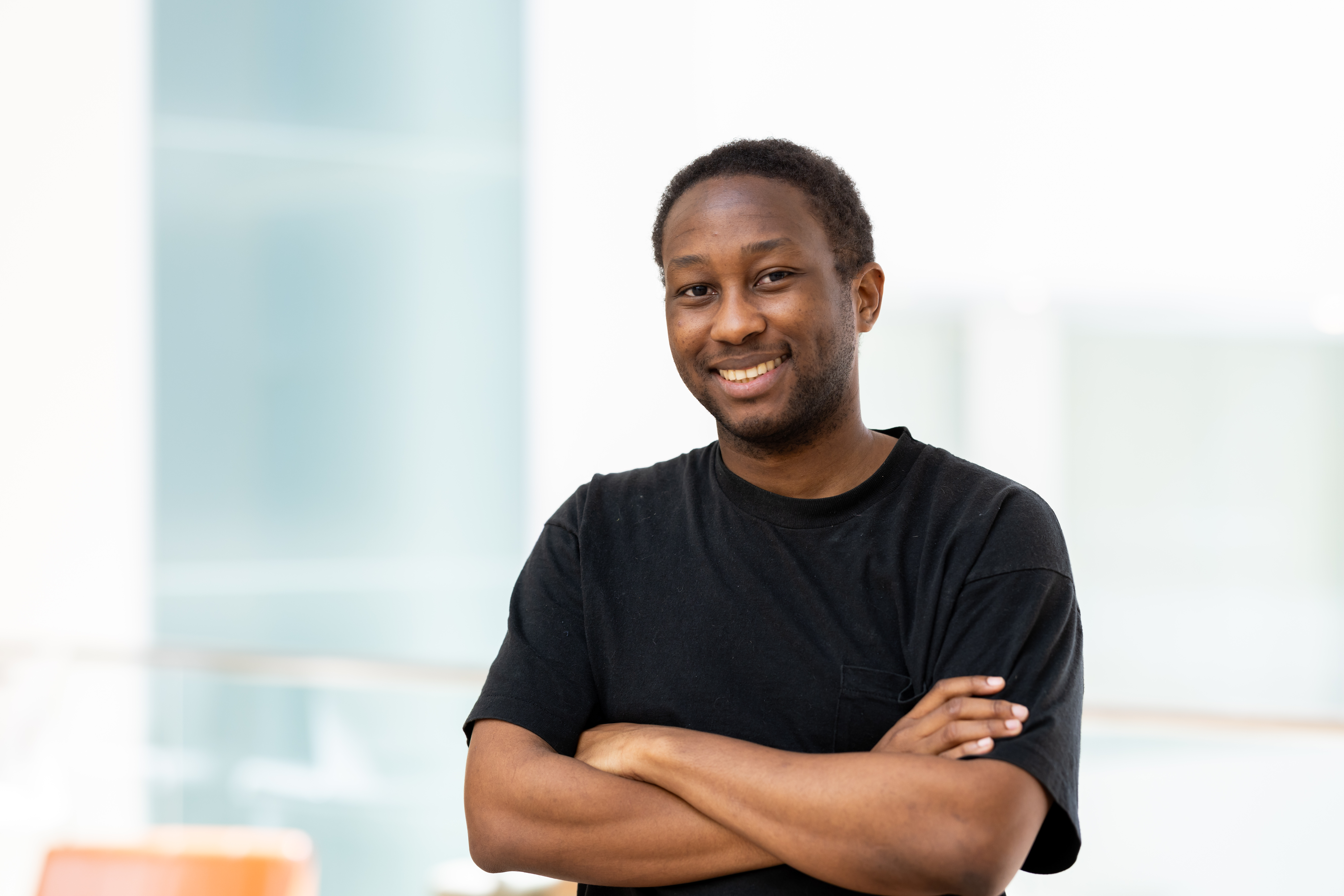
About me
Hi, I’m Quilee Simeon, a research engineer trained at MIT working at the intersection of machine learning, neuroscience, and scientific computing. I’m currently work part-time with MIT’s Office of Research Computing and Data, and hold an M.S. in Computational Neuroscience and a B.S. in Computation and Cognition from MIT.
🧠 Research Focus
My work centers on multimodal neural data modeling as a platform for understanding how biological neural systems process information. I integrate data across neural dynamics, connectomics, and transcriptomics using machine learning frameworks including transformer architectures and self-supervised learning.
Key Research Areas:
- Multimodal neural data integration and modeling
- Self-supervised learning for neural systems
- Transformer architectures for time-series neural activity
- Graph-based learning approaches for connectome data
- Neural efficiency and interpretability
💼 Professional Experience
MIT Office of Research Computing and Data — Research Computing Technical Staff (Nov 2025 – Present)
Numenta, Inc. — Machine Learning Research Intern (June 2025 – September 2025)
- Developed distillation methods for transferring sparsity patterns from large to small models
- Designed sparse weight and activation mechanisms for efficient inference
- Contributed to external collaboration on LLM inference optimization
MIT Department of Brain and Cognitive Sciences — Graduate Researcher (2022 – 2025)
- Built large-scale data pipelines for multimodal neural datasets
- Modeled neural population dynamics using graph-based architectures
- Integrated transcriptomic and anatomical data for neuron identity prediction
🛠️ Technical Expertise
Machine Learning & AI: Transformer models, contrastive learning, spectral normalization, diffusion models, reinforcement learning, neural network interpretability
Scientific Computing: Python, PyTorch, Julia, high-performance cluster computing (SLURM-based systems)
Data Engineering: Neural data preprocessing, signal aggregation, connectome-based modeling
Software Tools: NumPy, PyTorch Geometric, OpenAI API, Hugging Face Datasets, Matplotlib, Marimo/Pluto notebooks
🎯 Current Direction
I’m transitioning toward applied ML and AI systems roles that blend algorithmic research with scientific applications. I’m particularly interested in:
- Building generalizable models that bridge biological and artificial intelligence
- Working in collaborative environments that value both research depth and practical engineering
- Expanding expertise in reinforcement learning, generative modeling, and distributed systems
I’m open to Research Engineer, Applied Scientist, or ML Systems positions.
🏅 Leadership & Community
- Co-President, IEEE-HKN (Eta Kappa Nu) Honor Society — MIT Chapter
- MIT Black Student Union — Social Chair
- Secretary, Beta Chapter of Theta Chi at MIT
- Mentor and advocate for open science, data transparency, and interdisciplinary education
- Strong commitment to supporting underrepresented minorities in STEM
🌍 Background
I grew up in St. Lucia and completed my B.S. in Computation and Cognition (minor in Statistics & Data Science) and an M.S. in Computational Neuroscience at MIT. Outside of research, I enjoy reading fiction, hiking, and traveling to understand different cultures.
“I’m driven by the idea that understanding intelligence — biological or artificial — means learning how information transforms meaningfully through systems.”